
Small cells for local authorities
Supporting better mobile connectivity in towns and cities
Reliable mobile connectivity increasingly underpins how towns and cities work
Small cells can help improve mobile coverage and capacity in locations where existing mobile networks needs support.
Small Cell Forum brings together the mobile industry and local authorities to improve understanding, share experience and help address the practical challenges involved in deploying small cells in towns and cities.
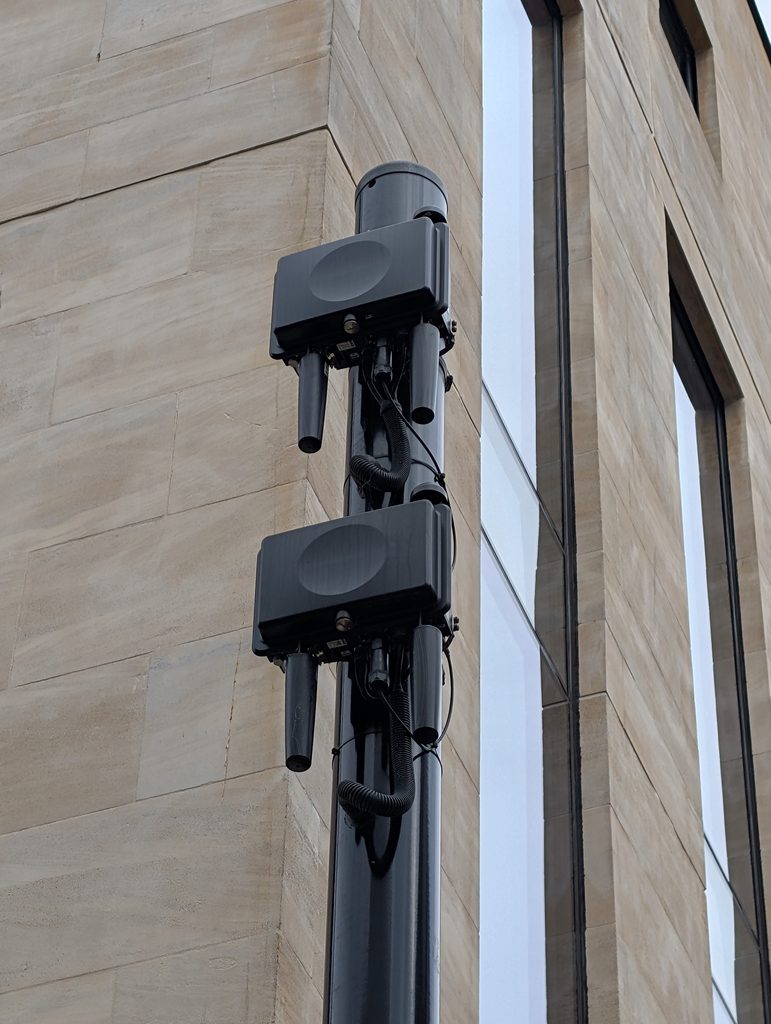
What are small cells?
Small cells are compact mobile base stations that improve mobile network coverage and capacity in a specific local area.
Unlike large mobile masts, small cells can add targeted capacity or coverage where it is needed most. They can be installed on suitable street furniture, buildings and other local infrastructure, depending on factors such as location, permissions, power and fibre availability.
They work alongside the wider mobile network rather than replacing it.
Why deploy small cell networks in towns and cities?
Better mobile connectivity helps towns and cities work as people expect, enabling local authorities to deliver against a range of wider priorities:

High streets and town centres
Supports card payments, visitor experience, businesses, events and footfall.

Transport corridors
Supports journey information, operational communications and passenger connectivity.

Public services
Supports mobile working, field staff and access to digital council services.

Economic development
Improves investor confidence and supports digitally dependent businesses.

Digital inclusion
Helps residents access mobile-first services where fixed connectivity or indoor Wi-Fi is not enough.

Public safety and resilience
Supports communications and coordination in busy or disrupted environments.

Smart places
Supports sensor networks, environmental monitoring and future connected-place use cases.
The role of local authorities
Local authorities can play an important role in enabling deployment. This can include helping identify where better connectivity is needed, making suitable public assets easier to access, establishing clear routes for engagement and bringing together the council teams involved.
Resources for local authorities
SCF is developing practical resources to help local authority teams understand small cells and the considerations involved in supporting deployment.
Guide to small cell connectivity for local authorities: Part 1
A free practical introduction covering what small cells are, why they matter for towns and cities, how they can be deployed and how local authorities can support deployment.
Guide to small cell connectivity for local authorities: Part 2
Putting small cell deployment into practice. Part 2 will look in more detail at the practical steps and considerations for local authorities moving towards deployment.
Local Authority Connectivity Group
SCF’s Local Authority Connectivity Group brings local authorities and the wireless industry together to support better connectivity in towns and cities. It provides a forum for local authority teams to learn from other councils, engage with the industry and share the practical issues they are encountering.
The group is currently focused on the UK and is free for local authority employees to join.
Frequently asked questions
A small cell is a cellular base station with low power and small form factor. In most cases, it services a small coverage area
No, small cells are complimentary to the coverage provided by mobile masts. Masts provide wide, broad coverage of areas. Small cells provide infill and enhanced capacity for areas where the mast coverage is weak or impaired by a lot of buildings, or where extra capacity is needed in high footfall areas. They are also used to improve mobile coverage inside buildings.
No small cells are for 4G and 5G and will be for 6G when it comes.
Small cells can be deployed for both indoor and outdoor coverage. In fact the biggest market for small cells is in indoor. However the radio units need to be deployed inside the buildings to achieve the improved coverage and capacity in a building. Small cells deployed outdoors may provide incidental improvement to indoor coverage but it’s not the primary purpose.
Mobile operators will look at a range of factors when considering deploying small cells, including the current level of network coverage in an area and the requirements for mobile connectivity. Each operator has its own requirements and processes. Neutral host providers can also assess locations and help find viable solutions.
Small cells need to be installed at minimum heights, as required by law and therefore they need to be on a tall asset. Lighting columns are ideal but other assets can be used such as phone boxes and even church spires.
Small cells are relatively compact pieces of equipment mounted onto assets like lighting columns. They can be painted to match the colour of the asset to reduce visual impact. Opting for multi-operator small cells, and neutral host deployments you can reduce the amount of equipment required.
Mutli-operator small cells can host more than one operator, in the UK it’s possible for all three operators to be running from the same equipment. This is usually (though not exclusively) deployed by a neutral host provider.