Insights from the Global Space Connectivity & Sustainability Event, Riyadh, Saudi Arabia, 12–14 October 2026
How will satellite, aerial and terrestrial networks work together to deliver the connectivity that people, businesses and critical services increasingly depend on? This was a central question at the Global Space Connectivity & Sustainability Event, held in Riyadh from 12–14 October 2026 by Saudi Arabia’s Communications, Space and Technology Commission (CST), in collaboration with the International Telecommunication Union (ITU).
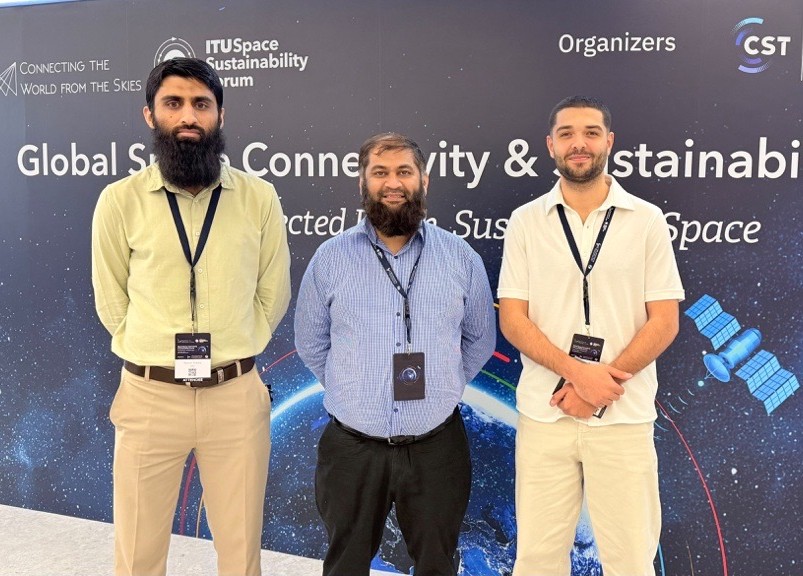
Ali Ahmed, R&D Manager from ACES attended on behalf of Small Cell Forum (SCF), along with other members of the ACES team, engaging with regulators, industry leaders and technology providers on the future of integrated connectivity. Discussions highlighted important developments in non-terrestrial networks (NTN), spectrum policy and High-Altitude Platform Stations (HAPS), with clear implications for the wider wireless ecosystem – an area SCF is interested in as part of the ‘NTN and small cells’ work item.
SCF members can access the full event presentation review by ACES on the member sharepoint. A short, summary blog is provided below:
- Terrestrial networks remain the backbone
A consistent message from speakers, including representatives from Aramco Digital and STC, was that satellite connectivity should extend terrestrial networks, not replace them.
Aramco Digital highlighted its 450 MHz terrestrial network, which provides high-capacity, low-latency connectivity for industrial operations and remote field locations. Satellite links can extend that network to assets beyond terrestrial coverage, improving operational continuity without displacing the terrestrial infrastructure on which critical services depend.
STC similarly positioned satellite direct-to-device (D2D) services as an extension of existing mobile networks, with integration into the mobile core important for seamless user experience and handover.
The capacity distinction is significant. A French regulatory representative noted that satellite D2D coverage areas of around 20–30 km may offer approximately 100 Mbps of shared capacity. While useful for extending coverage, this cannot match the localised capacity required in dense urban environments, where many users need simultaneous high-performance connectivity.
High-Altitude Platform Stations (HAPS), operating at around 20 km altitude, offer another complementary layer. Professor Saifur Rahman of Virginia Tech discussed their potential to restore essential communications when terrestrial infrastructure is disrupted, including during natural disasters. Dr Islam Tanash of PMU explored how HAPS could provide wide-area coverage with lower latency, favourable link budgets and reduced Doppler effects compared with LEO satellites.
However, extending coverage is only part of the challenge. There is also a need for beamforming to direct radio resources towards areas of demand, spatial frequency reuse to increase capacity, and interference management to coordinate multiple beams within limited platform power and payload resources.
- Why small cells and indoor connectivity matter
The presentations reinforced the importance of a multi-layer architecture comprising satellite and HAPS, terrestrial macro networks, small cells and dedicated indoor systems.
Small cells provide localised outdoor capacity for mobile operators and enterprise or campus networks. They can densify the terrestrial network where demand is concentrated, while dedicated indoor systems support high user densities in offices, venues, commercial buildings and enterprise campuses. These networks can operate independently or integrate with mobile networks, including through network slicing.
The technical limitations of non-terrestrial systems make these localised layers particularly important. Chris Roberts of BAE Systems/Prismatic discussed the potential for HAPS to deliver stronger signals into buildings than LEO satellite D2D. But improved signal penetration does not necessarily translate into sufficient capacity or service quality for busy indoor environments. Dedicated terrestrial indoor infrastructure therefore remains essential.
- Regulation and collaboration will shape deployment
Integrating these network layers requires more than technical compatibility. Speakers highlighted six broad challenges for scalable NTN deployment: mobility and handover, spectrum coexistence, hardware limitations, interoperability, resilience and security, and sustainable economics and operations.
Moving between terrestrial, HAPS and satellite networks introduces different propagation delays, changing network topologies and the need to maintain session continuity. Common interfaces, repeatable multi-vendor integration, consistent identity management and coordinated routing are also needed to deliver a seamless experience across network domains.
Spectrum is another critical issue. The forthcoming World Radiocommunication Conference 2027 (WRC-27) will be an important milestone for satellite-to-device connectivity using IMT spectrum. Clear authorisation, interference protection and international coordination will be needed to support coexistence between terrestrial and non-terrestrial services.
For HAPS, national airspace approvals and fragmented cross-border processes remain barriers to commercial deployment. For small cells and indoor networks, the corresponding priorities include site approvals, neutral-host licensing, local and shared spectrum access, infrastructure sharing and private-network authorisation.
A shared opportunity for the wireless ecosystem
For SCF members, the message from Riyadh is that integrated connectivity depends on getting every layer to work effectively together. Satellite and aerial platforms can extend reach and improve resilience, but terrestrial macro networks, small cells and dedicated indoor systems remain fundamental to delivering capacity where it is needed most.
Progress will depend on collaboration across technology providers, operators, infrastructure owners and regulators to address the technical, regulatory and commercial barriers to deployment. This is precisely where industry collaboration can make a difference: helping the wireless ecosystem deliver scalable, sustainable connectivity globally.